
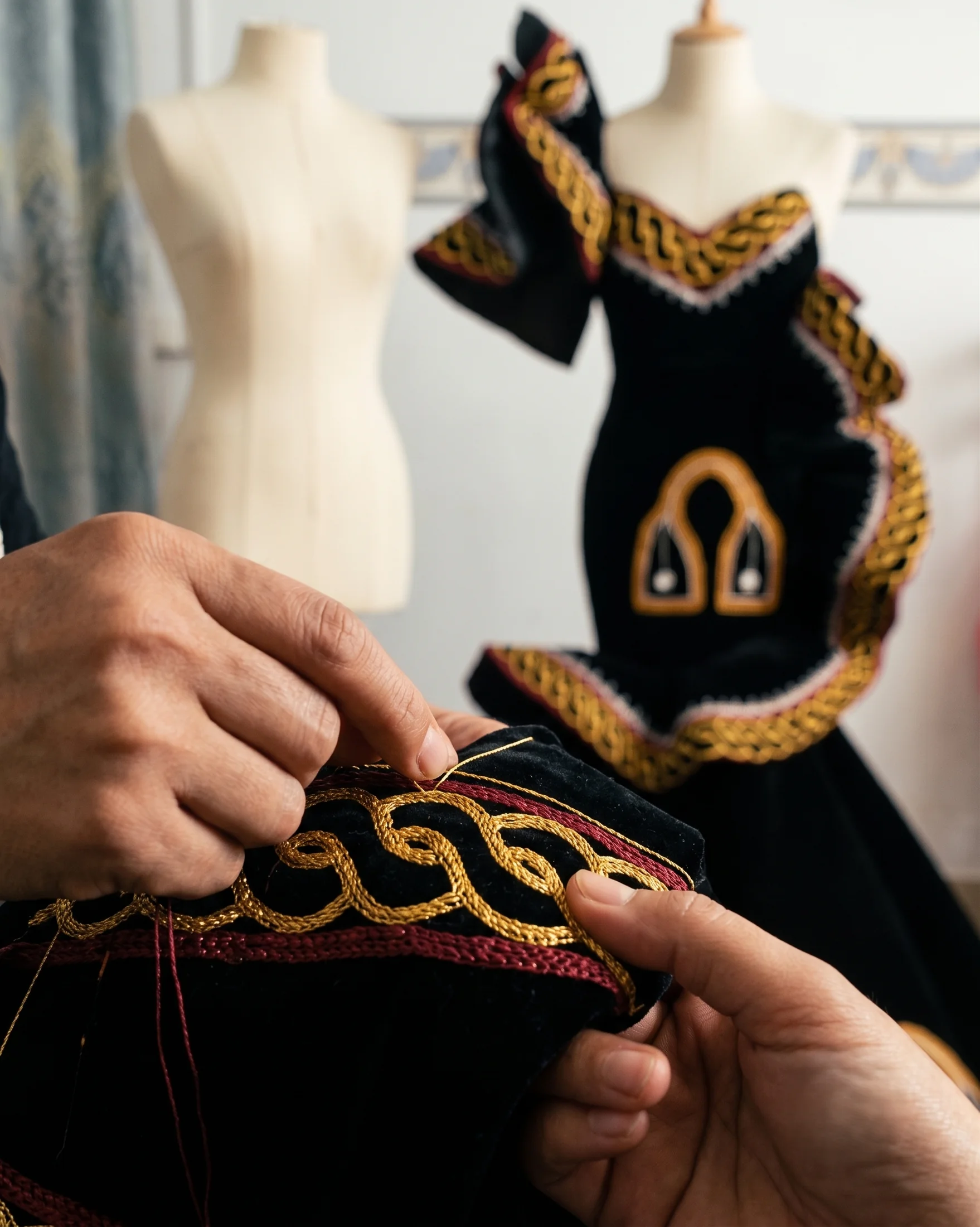
A cutter never asks the fabric to obey. She asks it what it already wants to do.
In the Kolo atelier in Douala, every commission begins the same way: not with a sketch, but with a hand laid flat on the cloth. Silk has a grain and a temper. Bouclé has opinions. Velvet remembers how it was folded. Before a single line is drawn, the cutter spends an hour simply listening through her fingers, where the weave relaxes, where it resists, which way the light wants to travel across the surface.
This is the first discipline of the house: the fabric leads, and the garment follows. It sounds like romance. It is closer to agriculture. You do not command a field; you read the season, the soil, the rain that already fell. Ivory silk from a certain mill will always fall heavier than its weight suggests. Gold thread from Varanasi behaves differently in the dry season than in the humid months of the Cameroon coast. A house that cuts for one woman only has no runway to hide behind, every decision is made against the specific behaviour of a specific length of cloth.
The vocabulary of touch
Over years, the hands of the atelier build a vocabulary. There are perhaps thirty words for drape among the cutters here, and none of them are written down. A fabric can be said to pour, to hesitate, to stand, to break, to forgive. Each word is a decision waiting to happen. When a client asks for a gown that holds the architecture of a ballroom but moves like water, the cutter knows before the sketch exists whether the cloth in stock can keep that promise.
The fitting room confirms what the cutting table suspected. A shoulder seam is a promise kept in millimetres. A hem is not a line but a negotiation between gravity and the body that will wear it. We say that our fitters alter garments; more honestly, they translate, between what the client imagined, what the fabric allows, and what the mirror will finally say.
Why this matters to the woman who wears it
A garment that was cut against its fabric fights the body all evening. It pulls at the shoulder, creases at the hip, requires its wearer to manage it. A garment cut with the fabric is quiet. It stops being something she wears and becomes something she is. That quietness is the entire point of the house. Presence is not volume; presence is fit.
So when we say that a Kolo commission takes eight, twelve, sixteen weeks, this is where the weeks go. Not into decoration, but into the unglamorous hours at the table where hands read fabric like Braille, and refuse to draw a single line until the cloth has finished speaking.