
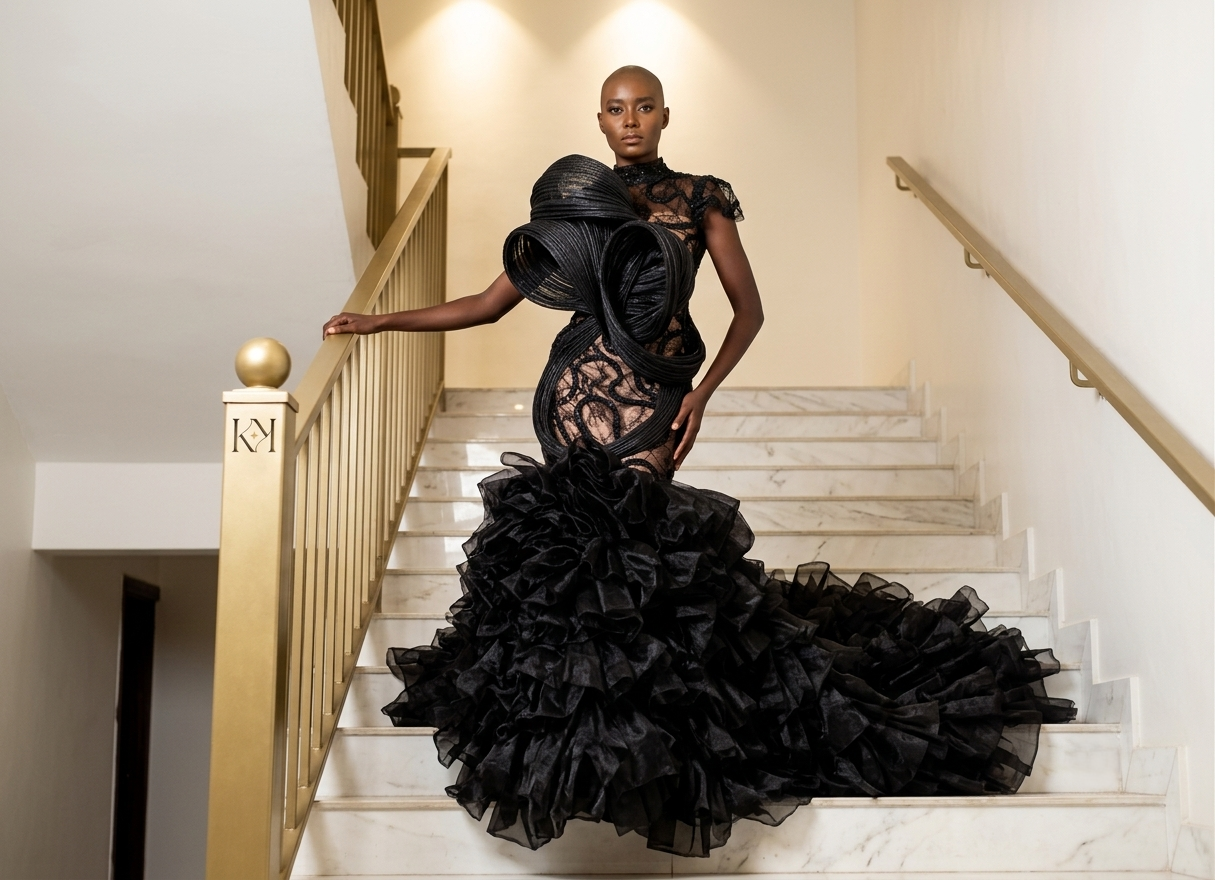
She does not enter a room. She revises it.
Every house that cuts for one woman only must eventually admit whom it is cutting for. The Kolo woman is not an age, not a profession, not a silhouette. She is a posture toward the world. She may be a lawyer in Douala who wears her grandmother’s gold to court. She may be a bride in Lagos who asked for a gown her daughter will one day argue over. She may be a collector in London who commissions nothing she could ever describe as practical. What she shares with the others is authority that does not announce itself.
We learned early that such women do not shop. They inherit, they commission, they decide. Ready-to-wear flatters the figure; bespoke flatters the life. The difference shows in the shoulder line, the place where a garment either obeys the body or argues with it, and it shows in the way a woman moves when she knows nothing about the evening ahead is left to chance.
Inheritance, worn
African dress has always understood this. The wrapper a mother wore to your naming ceremony is not fabric; it is a document. The toghu of the Cameroon grassfields is not decoration; it is jurisdiction, it says who may speak and where. Kolo stands in that lineage with modern instruments: the sculptural cut of a contemporary atelier, the hand embroidery of a workshop that refuses machines where a needle will do. Rooted in heritage, made for now. The Kolo woman wears that sentence without ever having to say it.
The commission as conversation
A commission begins with ninety minutes and no obligations. We ask different questions than a boutique asks. Not “what is the occasion,” but “which room will you need to hold?” Not “what are you wearing,” but “what do you refuse to be mistaken for?” By the second meeting the answers have become a sketch; by the fourth, a toile that will be taken apart twice. When she finally wears the garment, the room will call it style. We will call it the shortest possible description of one specific woman.